Notes From the Field | Sunday, 8 November 2026
There is something I’ve been thinking about lately. It has to do with the people around me, the people who support our work, and the people we meet at the Shared Table.
I seem to spend my time moving between two quite different worlds.
On one side are the people who support what we do. Volunteers, donors, community partners, friends and people who have become part of the wider circle around Food Not Bombs Hobart. There are now hundreds of relationships in that community. Many are remarkably consistent. People show up, send messages, make contributions, offer help and stay connected. They have their own lives, families, work and responsibilities, but somehow they make room for this work.
On the other side is the community we encounter through the Shared Table and our outreach. It’s a much more changing landscape. People come and go. Circumstances change. Someone finds accommodation, someone loses it. People disappear for a while and then return. Lives start up, stop, break apart and are rebuilt, sometimes more than once.
There is a great deal of uncertainty in those lives. What might look like a straightforward week to one person can be an enormous challenge for another.
And somewhere between these two worlds is where I find myself.
Standing in the middle
I’ve come to realise that I’m not simply connecting people who have resources with people who need them. I’m part of a network of relationships that operates in both directions.
I hear from people who want to help but aren’t quite sure how. I hear from people who need help but don’t always know where to turn. I see the different circumstances people live in, the opportunities available to some and the obstacles that seem to continually confront others.
Being in the middle gives me a particular vantage point. I get to hear both sides, understand something of their circumstances and sometimes bring things together that wouldn’t otherwise meet.
The linking makes sense of the mayhem.
Perhaps that’s one of the things community work actually does. It creates connections across lives that might otherwise remain quite separate.
Stability and interruption
I’ve noticed that the relationships around our supporting community are often much more stable than the circumstances of the people we meet at the Shared Table.
There is something reassuring about that consistency. People keep coming back. They keep asking how things are going. They remember, they contribute and they remain interested.
For some people, involvement in this work also seems to provide something they are looking for in their own lives: a sense of purpose, connection and the knowledge that what they do makes a difference.
Meanwhile, the people we meet at the table are often living with circumstances that make continuity difficult. The next week isn’t always predictable. Sometimes even the next day isn’t.
I don’t think these are two entirely separate communities. They are parts of the same community, but people experience very different levels of stability, security and opportunity within it.
The Shared Table is one place where those lives meet.
The direction of support
Something else has happened recently that has made me reflect on these relationships.
For most of the decade I’ve been involved in this work, I’ve been accustomed to organising support for other people. I’ve become quite comfortable being the person who makes the calls, finds the resources, arranges the connections and works out how to get things done.
But recently, a few people outside our usual core crew have found ways to provide some genuine help to me and to the project.
It’s a slightly awkward feeling.
Accepting something directly, rather than being the person arranging for it to go somewhere else, doesn’t come naturally. But I’ve also realised how much it can make a difference.
The project needs support too. We have limitations, including something as ordinary as how far we can drive the car. We use media and communication to reach people and make connections because we simply can’t be everywhere.
And when someone recognises that and offers practical help, it opens up possibilities.
Perhaps this is another part of the reciprocity of community. The relationships aren’t just about what one person can do for another. They become something that supports the whole network.
The importance of showing up
For all the communication, messages, partnerships and coordination, there is still something special about physically going out into the community.
We are often limited in how much travelling we can do. But when we do get out, something interesting happens.
We might visit one suburb and discover someone else nearby who could use a visit. We can double up. An unplanned stop becomes another opportunity to help.
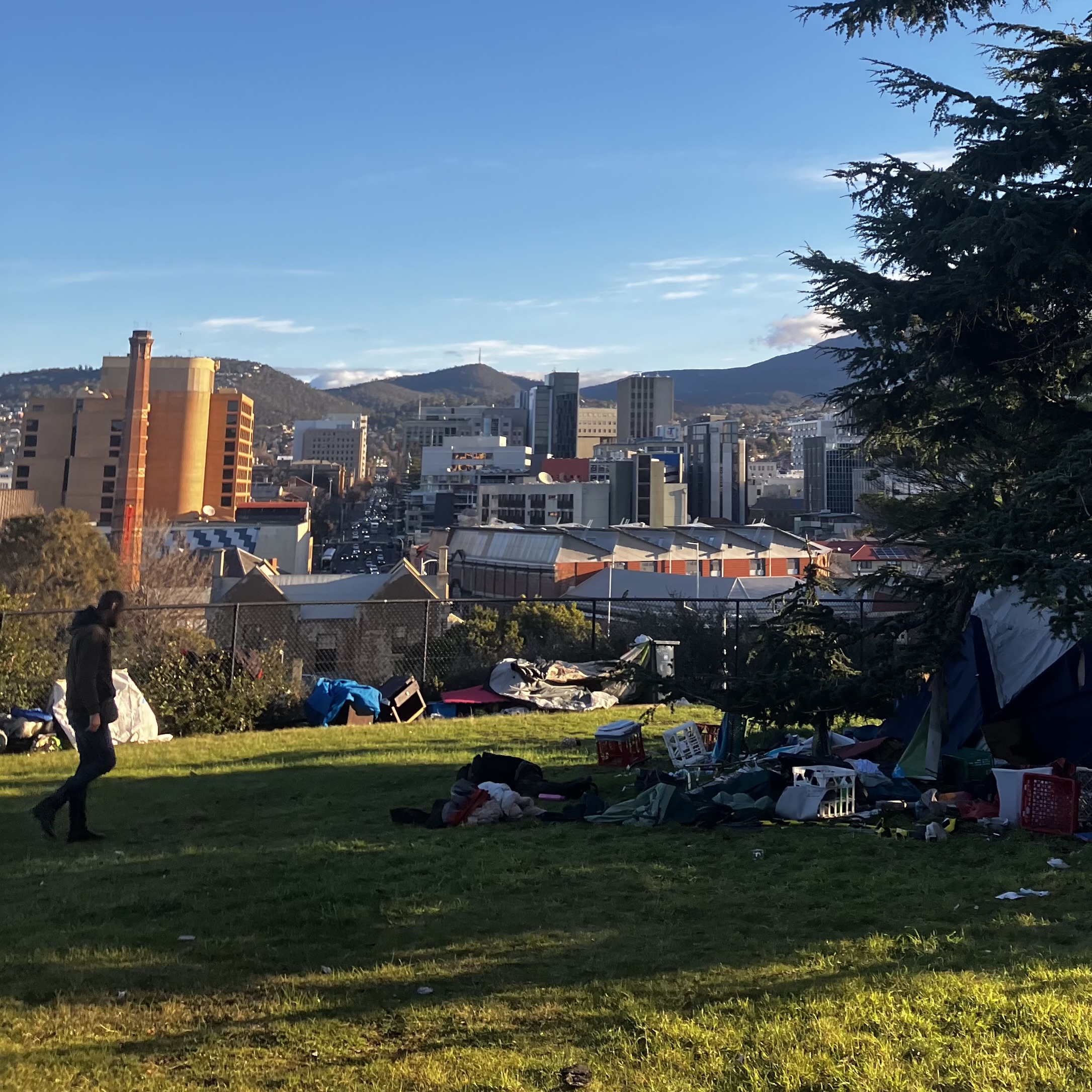
Walking around Hobart can be much the same. There are communities within the city, including street communities, that you don’t necessarily encounter unless you are actually there. Sometimes I can simply drop in, have a conversation and find out what’s happening.
These encounters are difficult to schedule. They don’t always fit neatly into a plan.
But they are part of what makes the work worthwhile.
Media helps us reach people. Relationships help us organise. Being physically present helps us understand.
We need all three.
The lives that meet at the table
I sometimes think about the differences between people living comfortably within the established economy and those living around its edges, on the margins, between the cracks.
They can inhabit the same city and yet experience very different worlds.
One person might be looking for a way to contribute something meaningful. Another might be trying to find somewhere safe to sleep tonight.
The circumstances are vastly different, but both are part of the community.
And perhaps the most interesting thing I’ve discovered is that the relationships between them can become meaningful in ways that neither might have anticipated.
The people who support this work help provide continuity. The people we meet through the work remind us why that continuity matters.
Neither side is simply giving or receiving. We are all participating in something that becomes larger than the individual contributions.
I don’t think a Shared Table fixes the instability in people’s lives. It can’t. But it can create a place where people meet, where relationships begin and where, for a little while, everyone has a place.
And sometimes, from those connections, something else becomes possible.
That’s the community I’m interested in building.

Leave a Reply