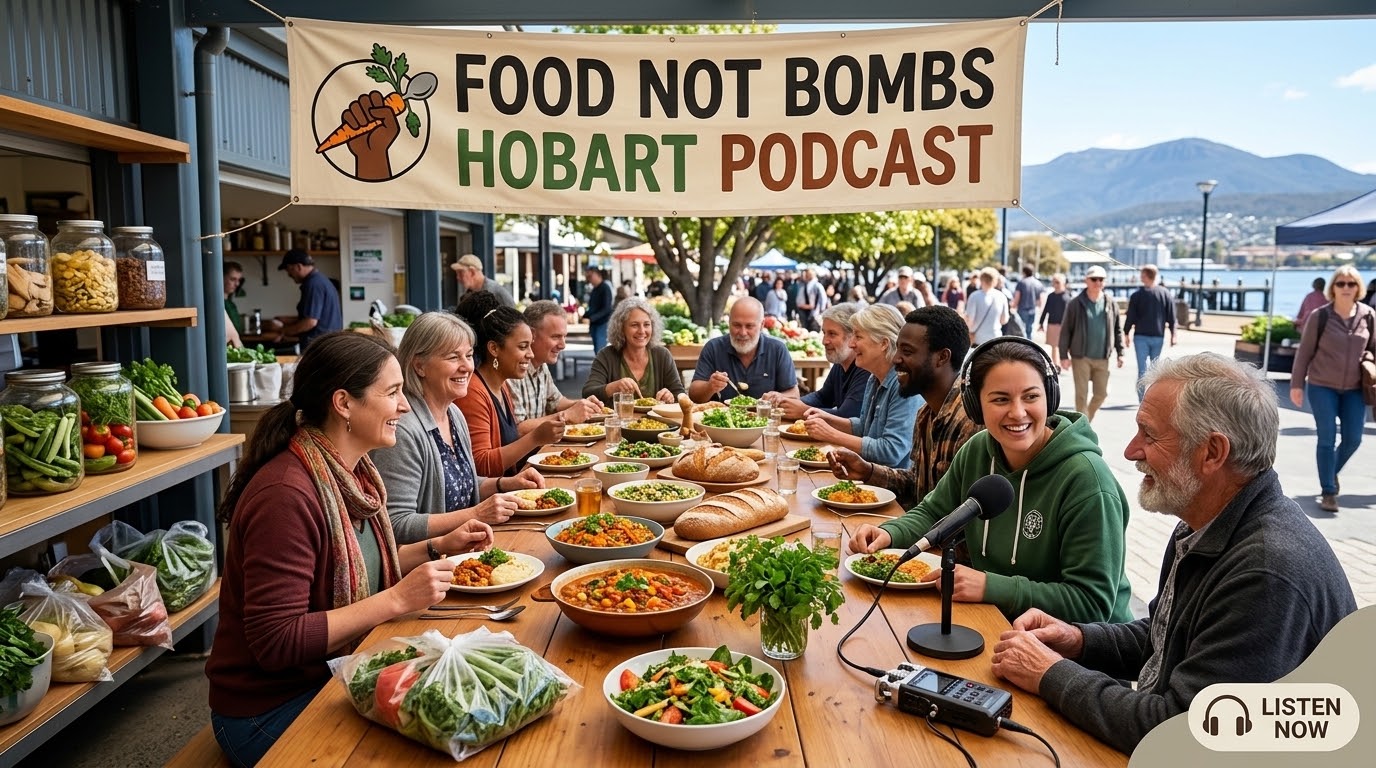
Pip: Most people see a bowl of soup. Christiaan, writing for Food Not Bombs Hobart, would like a word about that assumption.
Mara: This episode looks at what actually happens around the Shared Table — the community, the labor, and the kind of hope that shows up wearing an apron.
Pip: Let's start with what the project is really doing when it serves a meal.
More Than a Meal: What Happens Around the Table
Mara: The question this post opens with is deceptively simple: what does Food Not Bombs Hobart actually do? From the outside it looks like a food program. The post argues something more complicated is happening every single week.
Pip: The framing comes early and it's worth reading directly. "Around the Shared Table there is often less talking and more feeling. There is laughter, sadness, gratitude, frustration, hope, belonging and care all mixed together."
Mara: What that means in practice is that the meal is the structure, not the point. People arriving from more formal settings sometimes describe it as heavy on the feelings — because that much visible humanity is genuinely unfamiliar.
Pip: The post distills the actual experience to three words: sit, eat, talk. Which sounds reductive until you read what follows — new friendships, problems discussed, opportunities emerging. The basics are doing serious work.
Mara: There's a portrait of a newer volunteer named Shoko that makes this concrete. She cooks, serves, cleans, and leaves when the hall is locked. No performance, no overreach. Within weeks she became, as the post puts it, much loved — her presence part of what makes the table feel welcoming.
Pip: The post also draws a distinction that matters: food rescue describes the process, people power describes the structure. Every step from collection to serving happens because dozens of people contribute labor, vehicles, skills, and time. No single person holds it together.
Mara: And it pushes back on the charity framing directly. There are no paid positions, no bosses. Leadership emerges through service. The people who work hardest carry the most influence on the day.
Pip: There's a quieter argument running underneath all of this — that the people who show up, including those who've been dismissed or excluded, regularly surface wisdom and creativity that surprises even the organizers. The post calls them geniuses, and means it.
Mara: It closes on hope, and the definition it offers is grounded: "Hope isn't wishful thinking. Hope looks like feeding people when they are hungry." The ordinary actions are what make it believable.
Pip: The invitation at the end is the same three words it started with. Come and sit. Come and eat. Come and talk.
Mara: What stays with me is that distinction — food rescue is what they do, people power is how they do it.
Pip: And hope with a skeleton in reality. That framing is going to follow me around for a while. More next time.
Leave a Reply