The origins of FNB Hobart Makers go back further than Food Not Bombs Hobart.
In 2022, while studying social work at Deakin University, I travelled to Queensland with an interest in Aboriginal communities, community development and the role of Men’s Sheds. I wanted to understand how some of the ideas I was learning at university worked when I stepped outside the classroom and into a real community.
I arrived without a detailed plan. I had learned about approaching communities with a position of not knowing, and I wanted to spend time listening and learning rather than arriving with a program already designed.
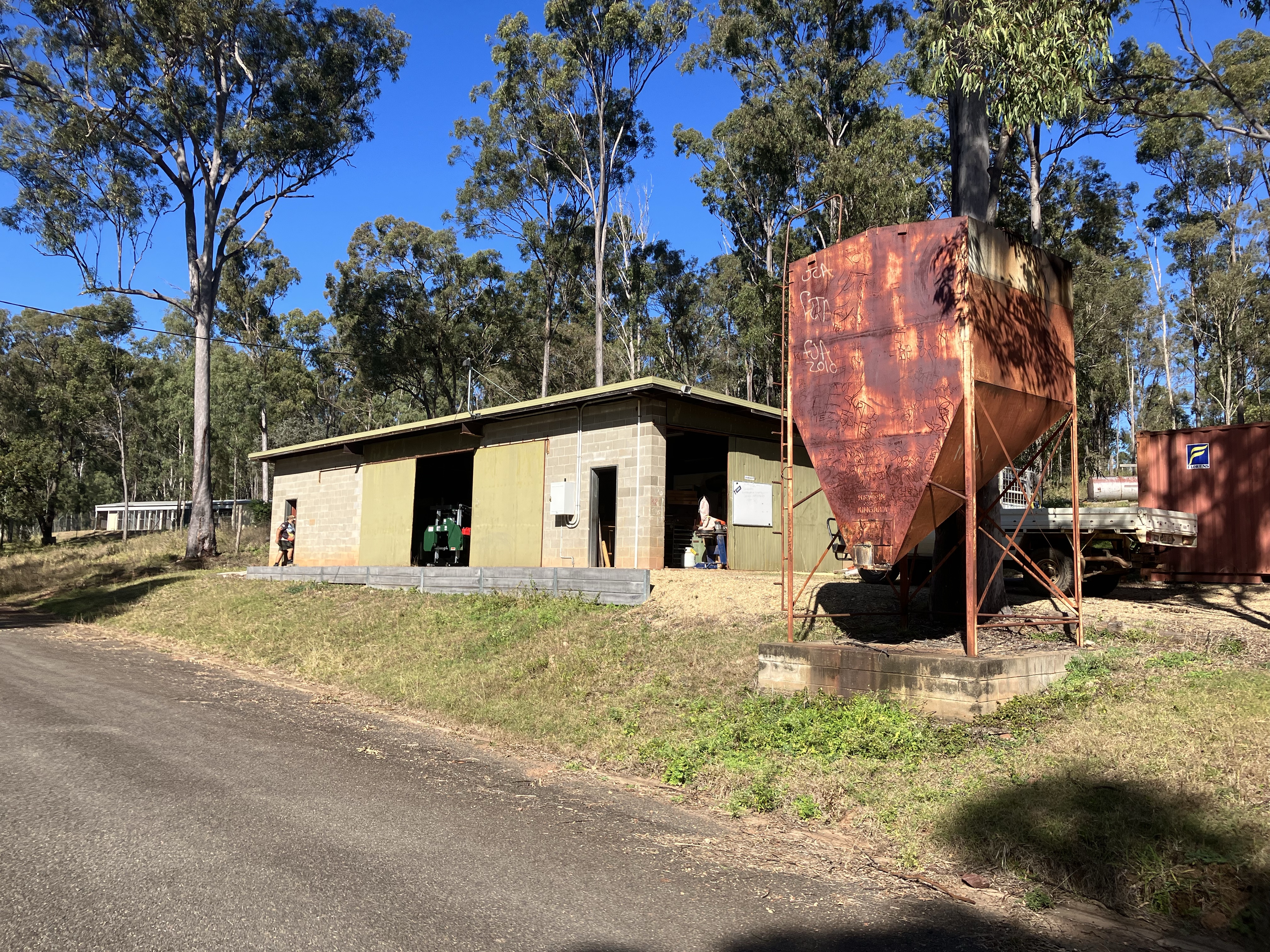
That journey eventually took me to Cherbourg.
Learning through woodwork
At the Cherbourg Men’s Shed I met Wayne, who supervised the shed. I came with experience in Men’s Sheds and woodworking, and I initially imagined that my contribution would be sharing some of what I knew.
I quickly learned that there was other knowledge I needed to understand first.
Woodwork gave us a way to spend time together. We worked with timber, used the machines, made things and talked. I completed several projects while I was there, including a cutting board and, on my last day, a bullroarer.
But the most important things I learned weren’t necessarily about woodworking.
I learned that relationships could be more important than getting the project finished. I learned that knowledge doesn’t always arrive in the form of someone explaining something to you. Sometimes it comes through watching, waiting, noticing what people do and understanding when it is appropriate to speak.
I also learned that my own sense of urgency could get in the way.
I’d arrived thinking about models, systems and things that could be produced. The people around me were teaching me that the relationships around the work mattered just as much as the work itself.
Making, ownership and history
One thing particularly stayed with me.
At the shed, people had their own projects and their own workspace. Some projects had been sitting there for a long time. From my perspective, it would have been easy to see unfinished work and think that the shed needed to be more organised or productive.
But I began to see another possibility.
For people whose communities had experienced generations of dispossession, ownership and having something that was yours could carry a significance that wasn’t captured by a productivity measure.
That changed how I thought about making.
I also visited the Ration Shed Museum at Cherbourg and spent considerable time reading its history. I discovered that woodworking and production had their own history in Cherbourg. Making things wasn’t simply an activity imported from somewhere else. There was a history of training, production and Aboriginal artefact making.
That gave me another way of thinking about the relationship between people, making, work and place.
From Cherbourg to FNB Hobart Makers
At the time, I had already been developing ideas about a woodworking model through Men’s Shed work with people with cognitive impairment. The idea was relatively simple: provide access to tools and materials, develop practical skills and create products that could potentially be sold.
But Cherbourg complicated that idea — in a good way.
It made me think less about a production system and more about the person doing the making.
What if the product wasn’t the most important outcome?
What if making something gave someone a reason to come somewhere, something to concentrate on, an opportunity to learn, a way to contribute, something they could own, or eventually a way of earning some money?
Those questions stayed with me.
Years later, they became part of the thinking behind what was initially called Microenterprise Builder and is now becoming FNB Hobart Makers.
The model has changed considerably since that first idea. It isn’t about imposing a production line on people. It is about finding what someone can do, what they want to make and what possibilities might exist around that.
Priscilla’s woodworking developed into Woodcraft Adventures Tasmania. Eamonn developed his art and craft. Other makers have experimented with their own products and ideas.
The principle has become increasingly clear:
The maker leads the project. They make it happen. We are the tools.
Looking back, I can see that my time in Cherbourg was part of the research behind this idea.
I went there thinking I was going to share knowledge about woodwork.
I came away understanding that how we make things together may be more important than what we make.
Leave a Reply